
Stair nosings play a crucial role in ensuring the safety of every stairway. They enhance visibility, provide additional grip, and help prevent slips, trips, and falls — some of the most common causes of workplace injuries. Whether in a commercial building, public facility, or industrial site, compliant stair nosings are essential for maintaining accessibility, reducing liability, and ensuring that stairs meet federal and local safety standards.
Across the United States, stair design and construction are governed by several key standards, including ADA stair requirements, IBC stair requirements, and OSHA stair regulations. Each set of codes outlines specific criteria for tread depth, riser height, nosing dimensions, slip resistance, and visual contrast. These rules are designed to protect building occupants and ensure stairs are safe for everyone — including individuals with mobility or visual impairments.
While the ADA, IBC, and OSHA provide nationwide stair code requirements, individual states and municipalities may have additional or more stringent rules. For example, some states adopt updated versions of the International Building Code sooner than others or add local accessibility amendments. Staying compliant with both federal and state-specific regulations helps property owners, architects, and contractors avoid costly penalties, retrofits, and — most importantly — potential safety hazards.
This page will break down the national stair nosing compliance standards and highlight key state-specific requirements to help you stay informed and compliant, no matter where your project is located.
The IBC sets construction standards that most U.S. states adopt, either fully or with modifications. Chapter 10 focuses on safe movement through buildings.
Notable sections include:
1003.4: “Circulation paths of the means of egress shall have a slip-resistant surface and be securely attached.”
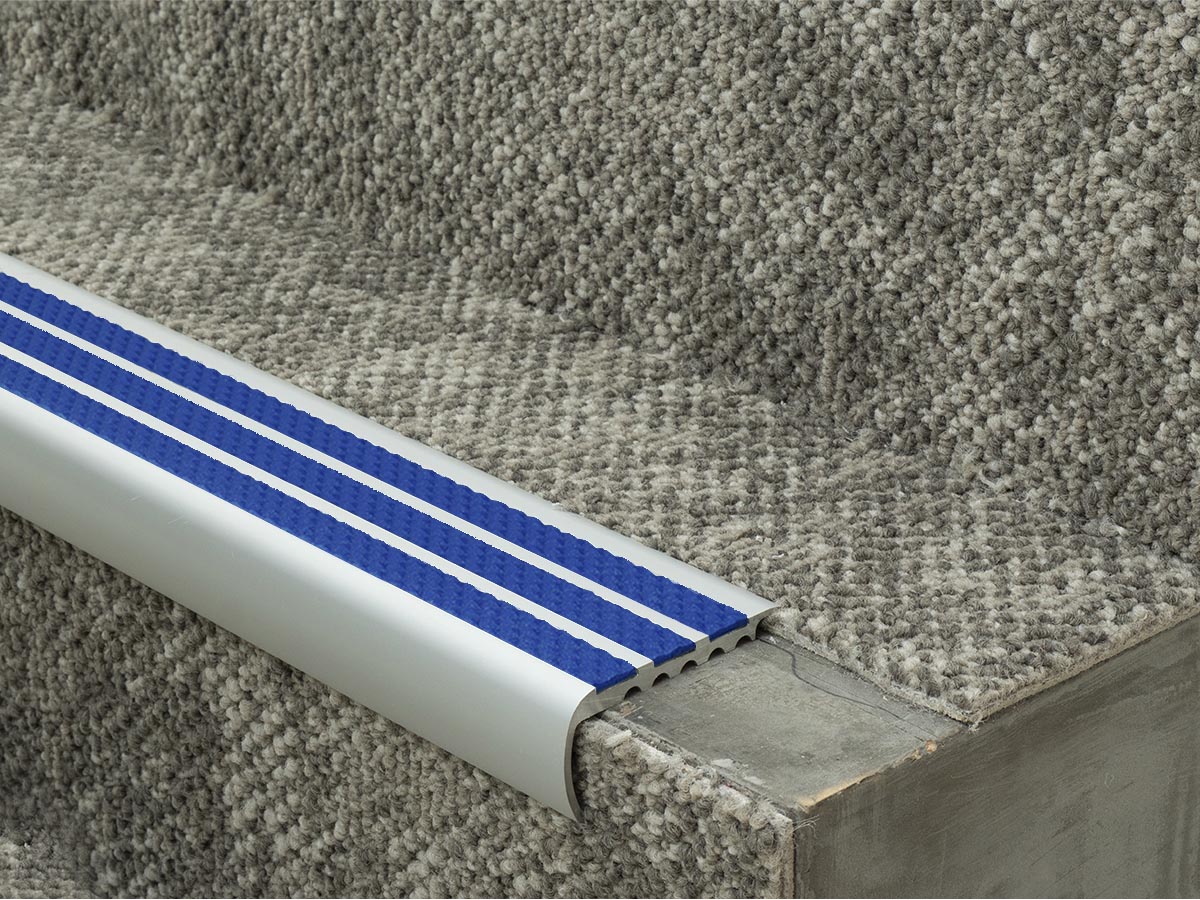
1029.14.2.3: “A contrasting marking stripe shall be provided on each tread at the nosing or leading edge such that the location of each tread is readily apparent when viewed in descent. Such stripe shall not be less than 1 inch and not more than 2 inches wide.”
→ This rule directly specifies visual contrast — defining dimensions for tread markings to ensure visibility when descending stairs.
1029.12.1: “The surface of aisles, stepped aisles, and ramped aisles shall be of slip-resistant materials that are securely attached.”
→ Again reinforcing the importance of traction and installation integrity.
Together, these IBC sections provide measurable, design-based standards for stair nosing performance and visibility.
The ADA prioritizes accessibility for people with disabilities, including individuals with low vision.
Key recommendation:
“Providing visual contrast (light-on-dark or dark-on-light) on the top and bottom of steps that is approximately 2 inches wide and located either on nosings or at the leading edges of treads is helpful for people with low vision.”
While not always mandated, this ADA recommendation strongly supports universal design principles. By enhancing contrast at stair nosings, facility designers can improve accessibility for everyone — especially those with visual impairments.
The Occupational Safety and Health Administration (OSHA) establishes baseline workplace safety rules for walking and working surfaces, including stairs.
Key requirements include:
1910.22(a)(3): “Walking-working surfaces are maintained free of hazards such as sharp or protruding objects, loose boards, corrosion, leaks, spills, snow, and ice.”
→ This provision emphasizes maintenance and hazard prevention, requiring employers to keep stair surfaces in safe condition at all times.
1910.22(c): “Access and egress. The employer must provide, and ensure each employee uses, a safe means of access and egress to and from walking-working surfaces.”
→ Employers must ensure stairs and exits are safe, accessible, and properly maintained for daily use and emergency situations alike.
Together, these sections form OSHA’s core mandate for stair safety in workplaces — focusing on both prevention and access.
The National Fire Protection Association’s (NFPA) Life Safety Code governs safety in buildings during emergencies, particularly regarding exits and evacuation routes.
Relevant provisions:
7.1.6.4: “Walking surfaces in the means of egress shall be slip resistant under foreseeable conditions.”
→ Surfaces, including stair treads and nosings, must maintain adequate slip resistance, even in wet or high-traffic scenarios.
7.1.7.2.4: “The presence and location of each step shall be readily apparent.”
→ This clause supports visual differentiation, ensuring each step’s edge is clearly visible — an essential factor in preventing missteps during low visibility or high-stress evacuations.
Across these regulations, several consistent themes emerge:
Slip resistance is universally required across all major standards.
Visual contrast and tread visibility are essential for safety and accessibility.
Secure installation and maintenance are fundamental for compliance.
Clear access and egress provisions ensure safe movement in everyday and emergency conditions.
These nationwide codes form the foundation of stair safety compliance in the U.S. — but note that individual states and municipalities may have additional or more specific requirements, which should always be reviewed in conjunction with these federal standards.
“Interior stairs shall have the upper approach and lower tread marked by a stripe providing clear visual contrast. Exterior stairs shall have the upper approach and all treads marked by a stripe providing clear visual contrast.”
“The stripe shall be a minimum of 2 inches (51 mm) wide to a maximum of 4 inches (102 mm) wide placed parallel to, and not more than 1 inch (25 mm) from, the nose of the step or upper approach. The stripe shall extend the full width of the step or upper approach and shall be of material that is at least as slip resistant as the other treads of the stair. A painted stripe shall be acceptable. Grooves shall not be used to satisfy this requirement.”
Steps in stairs shall be designed wherever practicable so as not to have abrupt (square) nosing. AND Steps should, wherever possible, and in conformation with existing step formulas, have risers that do not exceed 7 inches.
Floors shall wherever practicable have a surface that is nonslip.
“(7) All treads must be slip-resistant and the nosings must be a nonslip finish…..Treads must not be loose. Replace or repair defective treads quickly.”
(f) Where material of stair treads and landings is such as to present a danger of slipping, nonskid material shall be applied.
Detectable nosings with contrasting color are required for stair steps leading to public entrances of public buildings. These nosings must be 1-2 inches wide for the entire length of each step edge, and be implemented within 90 days after a public building is constructed, renovated or purchased.
504.7 Wet Conditions. Stair treads and landings subject to wet conditions shall be designed to prevent the accumulation of water. Advisory 504.4 Tread Surface. Consider providing visual contrast on tread nosings, or at the leading edges of treads without nosings, so that stair treads are more visible for people with low vision.
WAC 296-307-26024 Requirements that apply to stair treads (3) All treads must be reasonably slip-resistant and the nosings must be of nonslip finish.
Stair treads must be constructed to provide a firm and safe foothold.
Specific stair tread nosing materials mentioned include aluminum, vinyl, or rubber, providing durable and safe edge protection on stairs.
504.5.1 The leading 2 inches (51 mm) of the tread shall have visual contrast of dark-on-light or light-on-dark from the remainder of the tread.